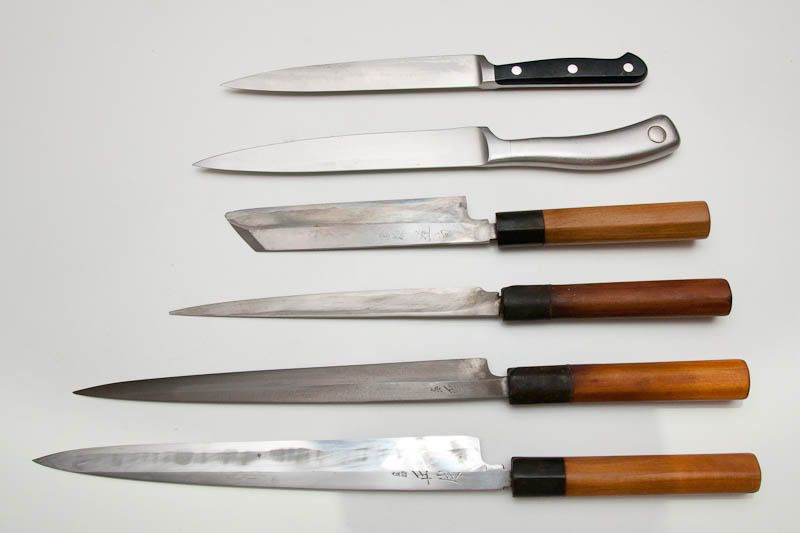
From the top:
- Henckels 18cm Fillet Knife
- Wustof 20cm Carving Knife
- 18cm Japanese 'Usuba' high carbon steel vegetable knife
- 30cm Japanese 'Yanagiba' high carbon steel sushi/sashimi knife. Well, it used to be 30cm. Now it's 22cm from 24 years of use - it was given to me by the owner of the restaurant I used to work at after he'd used it for 12 years.
- 30cm Japanese Masamoto brand 'Ao-ko Layered Steel Hongasumi Yanagi' sushi/sashimi knife. This is a super high carbon (Ao-ko) steel knife. This is my most expensive knife. It cost about $1000. This knife is made with the same type of steel used in Samurai swords and made using the same techniques. Many Japanese sword makers switched to making knives after Japanese feudalism ended in 1868. It's extremely hard, but brittle. It will keep its edge for weeks in a busy restaurant environment, but it also takes me over an hour to sharpen properly every time.
- 30cm Japanese Masamoto brand 'Ao-ko Hongasumi Yanagi' sushi/sashimi knife. This one cost $500. This is not as hard as my knife above, so it will not keep its edge as long (about 2 weeks), but is also much easier to sharpen.
*FYI:
Japanese knife makers have always chosen their materials carefully. Traditional sword craftsmen used a form of steel called tamahagane which is only produced in western Japan in a high heat smelter, or tatara. Tamahagane is made of iron dust and pure charcoal. Traditional craftsmen use tamahagane to produce swords that are both sharp and strong, but it is extremely expensive and difficult to forge. It is the ultimate material for sword making.Today’s chef knives are forged with similar methods used by sword craftsmen for generations using shiro-ko ("white steel") and ao-ko ("blue steel").
Shiro-ko and Ao-ko Carbon Steels:
Shiro-ko steel is a highly refined carbon steel that has no added ingredients (though it may contain varying levels of the impurities phosphorus and sulfur). Adding chromium and tungsten to Shiro-ko steel creates Ao-ko steel. With these additional ingredients, an Ao-ko steel blade becomes more durable, easier to temper, and capable of maintaining a longer-lasting edge than a Shiro-ko blade.
If you want to read up on Japanese knives, read this:
http://korin.com/Learn/About-Japanese-Knives