Quote:
Originally Posted by death_blossom

I'm not gonna go through this whole thread, but what are people's opinions on 5w20 weight oil?
I know this is what is recommended and used by manufacturers these days, for many vehicles. but personally, I don't believe in using such a low viscosity oil. I know it is more efficient (less friction for the engine components allowing better fuel consumption), but I feel that a 20 weight simply won't provide the type of lubricating protection that a 30 weight (or higher) would.
for example, the RX-8 is supposed to use 5w20 as per Mazda's manual. I'm sure the Renesis motor has mad many advances compared to the RX-7's 13b(t) engines of yester year, but it's still a rotary engine. an oil burning, gasoline guzzling rotary... using a low viscosity oil like 5w20 isn't going to help in the oil burning department.
discussions? can someone please fill me in on what I'm missing on using 5w20 oil.
|
It's just my opinion, but I believe 5w20 is not ideal for a number of reasons.
Here are my thoughts:
1. Any car that specs 5w20 can use 5w30 with no issues.
For example, in Japan, here is the manual for a car with the same engine in an RSX.
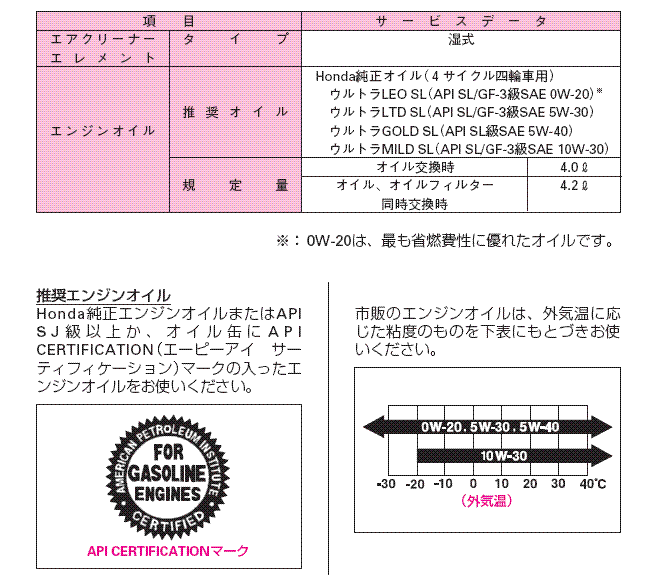
In the NA version, only 5w20 is recommended. Another thing to note is that in Japan for this engine, SL oils (an older spec) recommended where in NA, SM oil ir recommended.
2. Manufacturers that sell cars in North America that have lines of cars that use 5w20 qualify for fee reductions from CAFE regulations (corporate average fuel economy) This is incentive for car makers to push for 5w20.
Read:
http://en.wikipedia.org/wiki/Corpora...e_Fuel_Economy
3. Cars that spec's 0w20 and 5w20 initially had some problems with oil consumption, were then spec'd back to 5w30. 8th Gen Corolla is one of these cars, I believe there was a TSB issued for this.
4. Cars that used to use 5w30 were then spec'd to use 5w20. Same engine, same car, just different year. A couple Ford models had this.
5. 5w20 causes more wear that 5w30, although 5w20 provides
adequate protection as per SAE engine wear standards.
6. 5w20's promises of increased fuel economy are virtually undetectable, although if a million cars used 5w20 vs 5w30, there would be a difference.
So, conclusions. 5w20 and 0w20 cause very slightly more engine wear, slightly more oil consumption at the expense of very very little fuel savings per vehicle. Cars that spec 5w20 can use 5w30 with zero repercussions. (I have yet to see any evidence against this. Cars used to spec different grades of oil for different ambient temperatures all the time; now it seems that cars want to use a one-oil-fits-all approach.)
I believe in a car that specs 5w20, you can use 5w30, or even 10w30 with zero issues. If you check the pour point for synthetic 10w30, they're good for temperature warmer than -20C. Your engine is not going to explode if you use a different grade of oil. My car's spec'd for 5w20, but I use a 5w30.