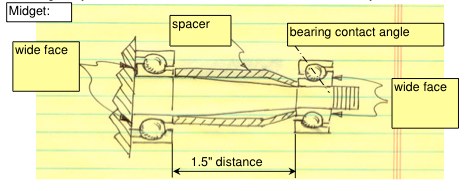
Well, I think I figured out the wheel bearing issue. Long story short, the outer wheel bearing was installed backwards. The inner race is width X (lets pick 3/4" as example dimension for discussion purposes). The outer race is 1/2 of X, say 3/8", and offset to one side. THUS, if the previous mechanic who replaced the wheel bearings puts the outer bearing in backwards, it will be 3/8" from bottom out on the step inside the hub. That means the hun as the potential of moving back and forth on the bearings which are tight...by about 3/8" of an inch. In my case, it was almost a 1/2" of side to side movement, walking on the bearings when I took the brake caliper off. :-O
If we ignore the potential wear between the outside of the bearing, and in inside of the hub, the outer bearing actually met the 'wear spec' in the manual for testing them. Hmmm. I can't measure the outside of the bearing, or inside of the hub accurately enough to determine if there was any wear, but I would suggest they reinstalled into the hub easier than I think they should have. Flipped the bearing around the correct way, reinstalled everything and got runout within spec. Going to give it a test drive later today to see if it fails again, but will be ordering the Moss taper bearing conversion kit regardless. What I really want to know, however, is how this wasn't a problem for the previous two owners (whom I know). Very strange. The only thing I can figure is the front left caliper, which I found to be seizing, wasn't doing anything...except holding the hub/disc in 'about' the correct location. Since I put a new caliper on, which could have the pads/pistons actually compressed, it allowed for the movement? Scary.
New hubs are $110usd, which might be a wise idea for the one side at least. Passenger side was installed correctly.
No adjustment Midget wheel bearing setup: